
On Monday, 9/8, sunspot AR2158 got a bit unruly and erupted in not one, but two solar flares directed toward Earth. The first flare was a moderately powerful M4.6 class solar flare. But AR2158 was just getting “warmed up”, so to speak, and let rip with a much more powerful X1.6 class solar flare on Wednesday. These flares stream off a tremendous amount of hot gas and charged particles that are called a coronal mass ejection (CME). Images of this flare and the comparative size of the sunspot that produced it are shown.

Sunspot Size Comparison

Solar flare From Sunspot AR2158
Particles from this CME started hitting Earth Thursday and continuing on into Saturday 9/13. A stronger CME (and our star can fling off some whoppers) along with the right alignment of the Earth’s magnetic field can produce really strong geomagnetic storms that can adversely affect satellites, communications systems and the power grid.
Fortunately for us, this storm has just produced a class G1 geomagnetic storm that may grow to G3 as the last waves of the CME hit us this weekend. While this is not enough of a storm to produce serious problems for communications and power systems, it is enough to jack up the nighttime Aurora Borealis displays visible in northern latitudes. A photo, taken from Maine, of the Aurora produced by this storm is shown below.
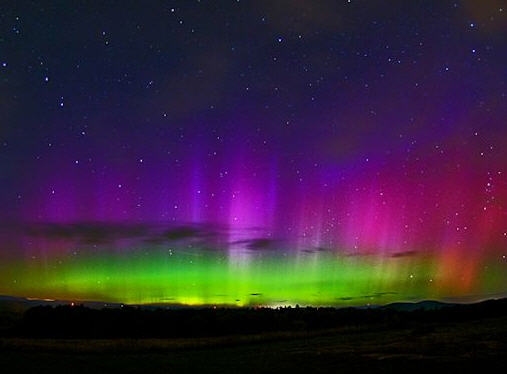
Aurora Borealis From Maine – AR2158 Flare
A much stronger geomagnetic storm in 1989 took Quebec’s power grid offline for a bit and in 1859, an extreme storm called the Carrington Event knocked out telegraph systems throughout the northern hemisphere and produced exceptionally bright auroras.
If you’re interested in reading more about this week’s solar storm, check out the following links:
Observing Space (includes a short vid of CME blow-off from the sun)
Mother Nature Network – multiple CMEs bombard Earth
And if you want to follow space weather and solar dynamics, in general, go to these links:
NOAA Space Weather
Spaceweather


