
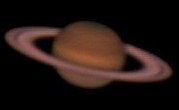
Greg B Saturn Image
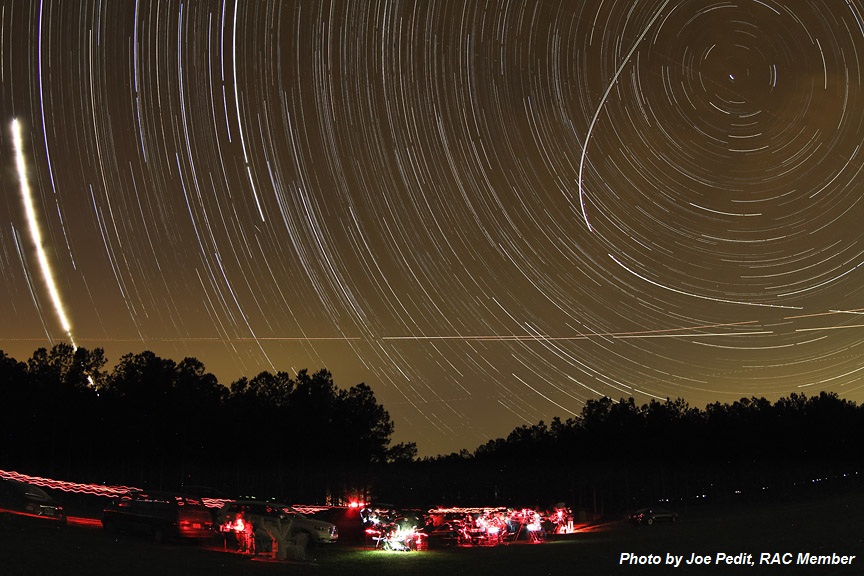 Despite the clouds, 12 people and 5 telescopes showed up at Big Woods last night. Joe P, Travis W, Greg B were imaging. Coin P and I were doing visual work and someone whose name I didn’t catch did visual work with a 6″ refractor. Several guests shared views with the visual observers.
Mark and I hosted Jerry on a hunt for planets and spring double stars. I’m glad I had prepared for a night of mediocre transparency (my edge-on galaxies will have to wait).
Here is a time-lapse video taken by Joe Pedit, RAC Member:
Below is a brief report of what we viewed. Not in the list but observed was M95 and its fading supernova.
Brief Observing Log Report Object Common Name Loc Method Instrument Eyepiece Barlow/Cmp Total Mag True Field Notes
Mars Manual 14.5″ Dob 12mm Nagler ParaCorr 158.8 x .52 Small but bright, markings are apparent and a hint of a polar cap. The seeing is not great, but sufficient.
Mars Manual 14.5″ Dob 09mm Nagler ParaCorr 211.8 x .39 The dark markings and polar cap are better defined at this power (211x). The north polar cap is small and well defined. Two markings are visible – the large one (syrtis major) and a ‘band’ in the southern hemisphere.
Saturn Manual 14.5″ Dob 12mm Nagler ParaCorr 158.8 x .52 Saturn is low in the east but Titan, Rhea and Tethys are apparent. These were identified using TheSkyX.
Saturn Manual 14.5″ Dob 09mm Nagler ParaCorr 211.8 x .39 Saturn is higher in the east but surface detail is soft. Cassini division is visible and we saw Titan, Rhea, Dione, Tethys and Enceladus. We could not see Hyperion.
Venus Manual 14.5″ Dob 12mm Nagler ParaCorr 158.8 x .52 A thick crescent appears bright and clear. No chromatic problems at this altitude (60d). No markings as usual.
WDS 08467+2846 STF1268 DSC 14.5″ Dob 20mm Nagler ParaCorr 95.3 x .86 Primary appears creamy yellow, secondary a very nice blue. Wide separation (30″) makes this an easy pair with very nice color contrast.
WDS 10200+1950AB STF1424 DSC 14.5″ Dob 20mm Nagler ParaCorr 95.3 x .86 Primary appears creamy yellow, secondary more orange. Cleanly split (4.5″). Very nice pair with slight color difference.
WDS 12351+1823 STF1657 DSC 14.5″ Dob 20mm Nagler ParaCorr 95.3 x .86 Primary appears yellow to me, and the secondary a pale blue. Perhaps the clouds are attenuating the orange (K) color to yellow. The secondary is not as blue as STF 1268. Separation is clearly less than STF 1268, but is a nice wide 20″. Another very nice pair.
WDS 12417-0127AB STF1670 DSC 14.5″ Dob 20mm Nagler ParaCorr 95.3 x .86 This is a repeat observation to test the telescope resolution and the seeing. Both stars appear white and they hint at being a pair at 95x.
WDS 12417-0127AB STF1670 DSC 14.5″ Dob 07mm Nagler ParaCorr 272.3 x .30 This is a repeat observation to test the telescope resolution and the seeing. The tight pair (1.1″) is cleanly split at 272x – a good result for the telescope!
WDS 14450+2704AB STF1877 DSC 14.5″ Dob 20mm Nagler ParaCorr 95.3 x .86 Bright yellow primary with a dim orange secondary. Perhaps clouds are making the orange primary look more yellow. The split is clean and easy so perhaps seeing has improved.
11 observations found
— Phyllis Lang: RACOBS Jordan Lake: 13-Apr2012


