
In mid-November, the European Space Agency successfully landed a washing machine sized probe, named Philae, on the comet 67P/Churyumov-Gerasimenko. Philae, and its mothership probe Rosetta, began their long journey to the comet ten years ago atop an Ariane 5G rocket launched from French Guiana.
Reaching this comet was not an easy task and took 3 flybys of Earth and one of Mars to use gravity assist to pick up the speed necessary to rendezvous with 67P. Rosetta has traveled 4 billion miles to reach the comet just inside the orbit of Jupiter. Along the way, Rosetta passed near the asteroids Steins and Lutetia and radio’d back images of these objects – some of the closest ever taken of asteroids.
The image on the left shows a scale model of comets 67P (left) and Siding-Spring (right) next to Los Angeles. The image on the right was taken from Rosetta of Comet 67P last May as the probe approached the comet. Comet 67P is the smudge in the red square just below image center. The globular cluster M107 is prominent near the left edge of the main image. M107 orbits the central hub of our galaxy.
![[Comet Size Comparison to Los Angeles]](https://raleighastro.org/wp-content/uploads/2015/05/Com67P_vs_SSpring_vs_LA.jpg)
[Comet Size Comparison to Los Angeles]

M107 and Comet 67P as seen from Rosetta
This past August, Rosetta finally chased down Comet 67P and dropped into an initial 62 mile high orbit about the comet. To take a closer look, Rosetta spiralled its way down to a 18 mile high orbit to do a detailed mapping of 67P. More recently, Rosetta descended into a tighter orbit in order to drop Philae onto the comet’s surface. All of which brings us back to Philae and its white-knuckled, multi-bounce landing on the comet. How do you land on something that has so little gravity? Very carefully. And the odd, two lobed shape of this comet made landing much more difficult.
Unfortunately, Philae ended up in shadows and cannot recharge its batteries. The probe is now dormant, but in several days of operation, measured complex organic molecules on the comet and took detailed images of the surface. As the comet moves closer to the sun, mission controllers hope that Philae’s solar panels will move into sunlight and be able to recharge the craft. If this happens, this little probe will produce some amazing science.
Meanwhile, Rosetta has mapped much of the comet and sniffed the gases thrown off by 67P as it heats up on its journey around the sun. Rosetta has already detected water, carbon dioxide, methane, alcohol, ammonia, formaldehyde and other complex molecules. More discoveries are expected as the comet approaches the sun. Comet 67P is currently (as of Nov 22) 271 million miles from the sun and 321 million miles from Earth. It is moving at 42,000 mph and it will accelerate to 84,000 mph on closest approach to our star next August. All the while, Rosetta will be orbiting the comet and watching what happens. Stay tuned – this should be a fun ride.
The images below show Philae descending to 67P, a view of 67P from Philae as it descends, and the 1st surface image of the comet taken by Philae.

Philae descending to the comet

View of Comet 67P from Philae during descent
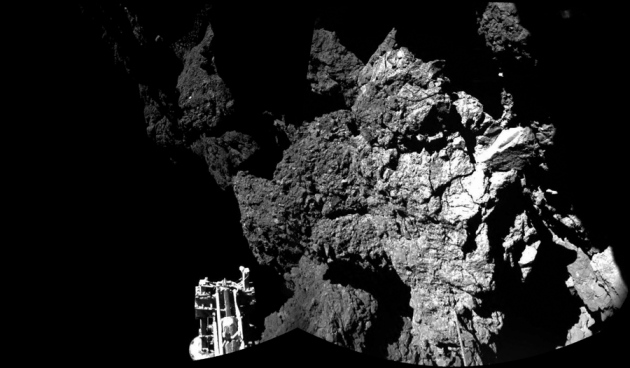
Surface image of 67P taken by Philae
These images show Rosetta’s launch aboard Arianespace flight v158 in 2004, ESA mission control in Darmstadt Germany and Rosetta’s 4 billion mile flight path to Comet 67P.
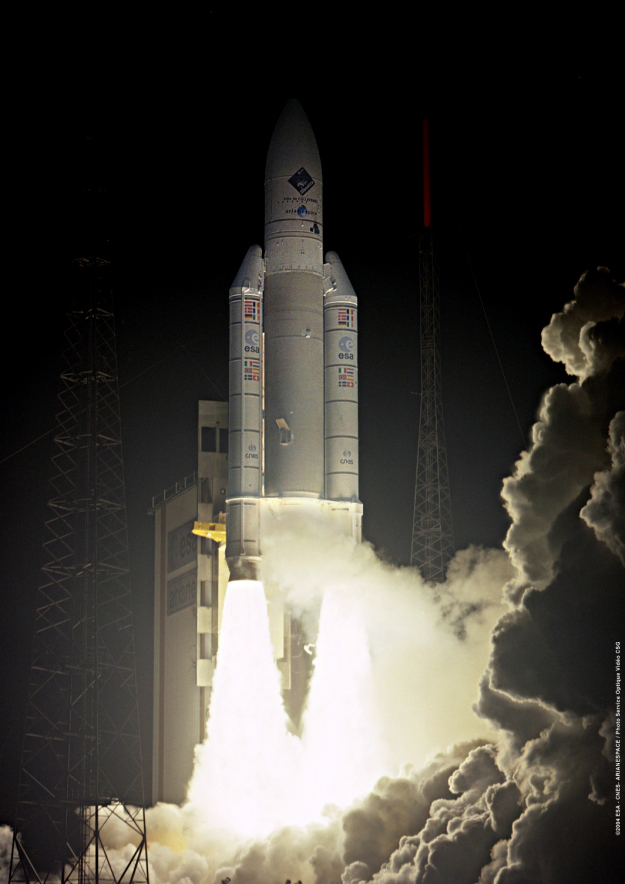
Rosetta launch aboard Ariane 5G rocket from French Guiana

ESA Mission Control in Darmstadt, Germany

Rosetta’s flight path to Comet 67P
To learn more about Rosetta and to follow the mission over the next year, check out the links below.
ESA Rosetta website: http://sci.esa.int/rosetta/
Track Comet 67P: http://www.livecometdata.com/comets/67p-churyumov-gerasimenko/
5 Amazing Facts about the ESA Rosetta Probe: http://www.space.com/26754-rosetta-comet-spacecraft-5-amazing-facts.html
How to land a probe on a comet: http://www.simpack.com/fileadmin/simpack/doc/usermeeting04/um04_maxplanck_hilch.pdf


