
Dr. Patrick Treuthardt, Ph.D. Assistant Director, NRC Astronomy Laboratory was the presenter in the December meeting. His talk was divided into three sections. The first he gave an overview of the formation and evolution of galaxies. The second section, he showed examples of different galaxy formation –both the expected and the unexpected. Lastly, he discussed some of the recent research in the field. All during the talk, he answered questions that came up.
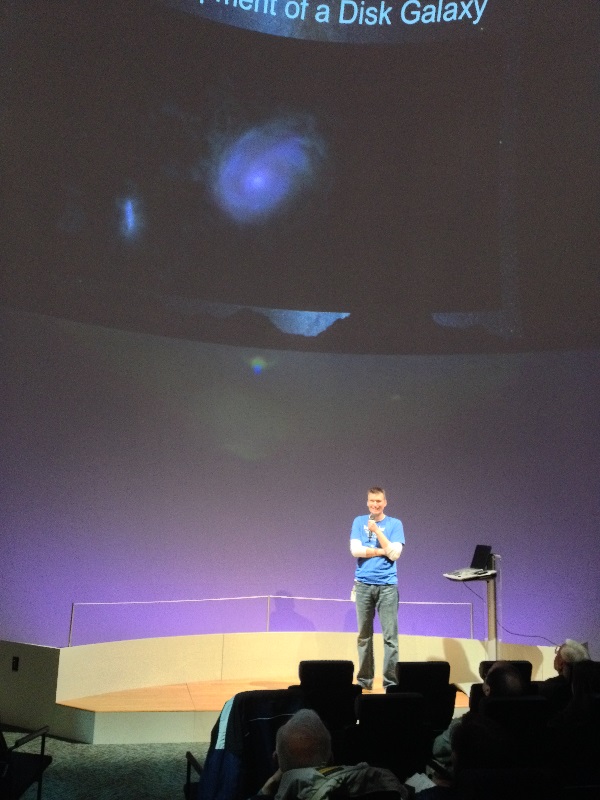
Patrick Treuthardt
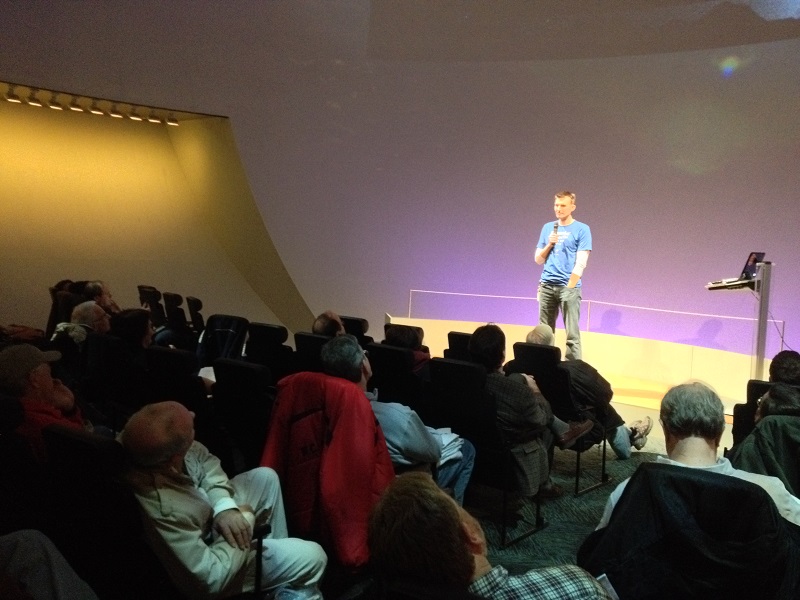
Patrick Treuthardt
In the first section, he went over the amount of dark matter in the Milky Way. In addition, he went over the Bullet Cluster and how this is the best observational evidence that dark matter is real. He explained how Gravitational Lensing assists in the observation and how dark matter is involved in bending the light.
In the next section, he went over the ideas of galaxy formation. The timeline that he used was from the Big Bang to the present. He explained how to read the Planck Telescope map of the Cosmic Microwave Background using the Black Body Spectrum. This helped to figure out the content of the universe. This content is as follows
- Normal Matter 4.9%
- Dark Matter 26.8%
- Dark Energy 68.3%
Next he went on to explain how the spiral galaxies and the elliptical galaxies are classified. He explained that all galaxies are thought to have a black hole in the center of them. In fact, you can see how big the black hole is by how tightly the spirals in a spiral galaxy are.
The last section concentrated on his research. He studies unusual galaxies. One of the tools that he uses are computer simulations. The goal is to see if you can recreate what you have observed.
This was a great talk. The level was just right for the audience. He encouraged questions from the audience.
In addition to the speaker, one of the club members – Doug Lively – completed the Astronomy League Hershel 400 program. He was awarded a plaque and a pin. This was a great accomplishment.


