
Is there any intelligent light out there? Not if we’re talking about the way we light our cities. Paul Bogard, author of The End of Night, gave an outstanding talk at our March meeting on light pollution and what we miss when we lose a dark night sky. About 100 people attended this joint meeting of RAC, the Audubon Society and the NC Herpetological Society to learn more about the impact of light pollution on the environment and our well being.
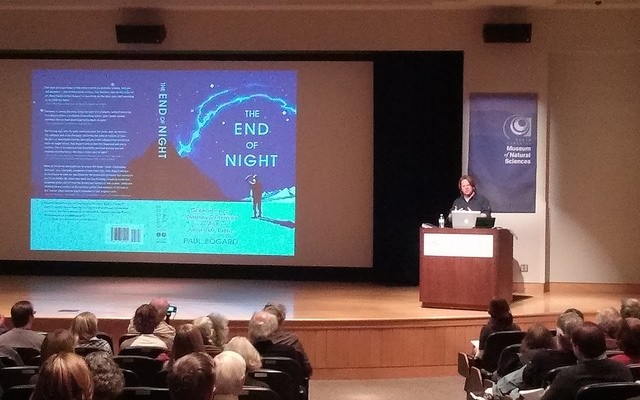
Paul showed composite satellite photos of the Earth at night to show the stunning growth of nightime lighting in recent decades. A computer simulated image of a 1950’s view showed dramatically less nightime lighting. We learned that 8 of 10 American children will grow up in cities where they will never see a dark night sky or the Milky Way.
This explosive growth in nightime lighting is the bad news. The good news is that we can do much better. Paul described how our lighting practices are pretty wasteful. He went on to describe how parking lot and street light fixtures that direct light downward, where it is really needed, greatly reduce light pollution. Better lighting design also saves money by allowing the use of dimmer lights to achieve the same result. The International Dark-Sky Association is working with the lighting industry and cities around the country on better lighting practices that hopefully will restore some of our night sky.
Paul discussed the Bortle scale (1-9) which is used to characterize the darkness of night sky. Las Vegas, the brightest spot on the planet, and major cities like New York have skies that rate as 9 on the Bortle scale. In other words, there is no night in these places. At the other extreme, a rating of 1 means that the night sky is untouched by artificial light. Stars can be seen all the way to the horizon in all directions. Paul told us that only 3 park sites in the United States, all out west, have been measured to provide Bortle 1 skies.
To learn more about the impact of light pollution, get a copy of Paul’s excellent book, The End of Night.
Paul’s website is: http://www.paul-bogard.com/
The club enjoyed this talk and extends its thanks to the NC Museum of Natural Sciences for organizing the event and to the Audubon Society and NC Herpetological Society for helping sponser Paul Bogard’s visit.


