
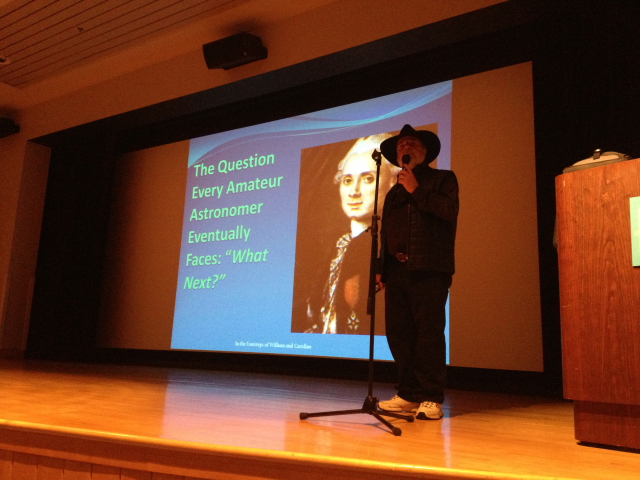
Author Rod Mollise Presenting on the Herschel 2500 Project
RAC was privileged to bring in Rod Mollise from Alabama for the April 2013 meeting. Rod is now a contributing editor for Sky & Telescope Magazine. He has recently completed a big project: observing 2500 deep-sky objects cataloged by William and Carolina Herschel. Rod began his discussion by giving the group a history lesson on the Herschel’s. Wilhelm and Lina (William and Caroline) were born in Hannover Germany in the early1700s. They emigrated to England. William was initially a musician then later an astronomer. William is most famous for discovering Uranus with a six inch telescope on March 13, 1781. Both William and Caroline worked on an extensive sky survey from England. William was the observer and Caroline cataloged the objects found. With her own telescope Caroline discovered eight comets. William constructed many telescopes including his famous 40 foot telescope. During their sweeps, the Herschels cataloged 2377 objects. Some of the original 2500 were duplicates and non-existent objects.
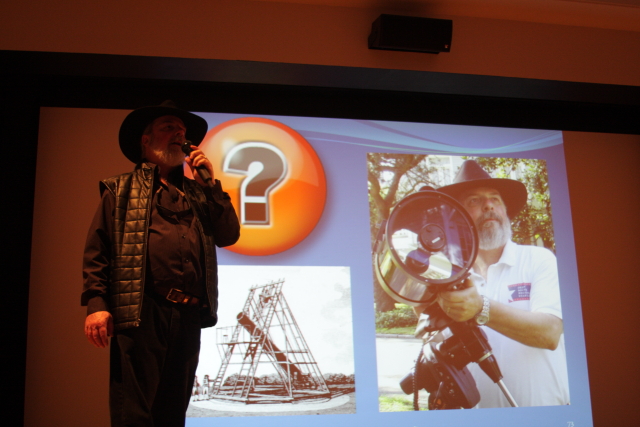
Author Rod Mollise Presenting on the Herschel 2500 Project
Rod explained that many amateur astronomers ask the question “What do I do next?” after finishing off lists like Messier’s. Rod wanted to do something different so he next started the Herschel 400. After that, he got the idea to observe all “2500”. He used a variety of scopes including an 8” SCT, an 11” SCT, and a 12.5” Dob. He observed many objects visually, but later started using a Stellacam to observe digitally.
Rod offered the following tips for observing the Herschel 2500. Here is what you need:
Rod recommends three books on the subject: There were plenty of questions and answers with the audience to round out a very entertaining evening. Meeting summary contributed by Mark Lang


